Inferring the latent network of pairwise mutualistic preferences from observed plant–pollinator interactions
Abstract
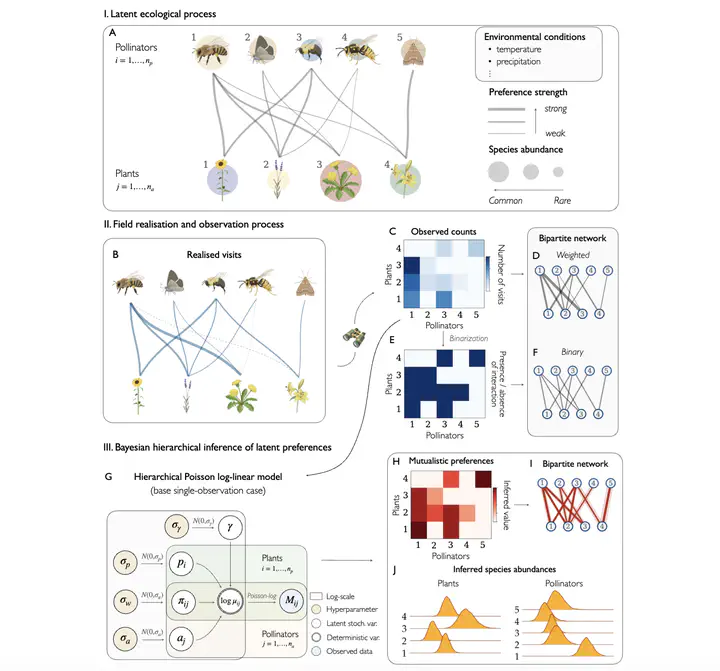
Plant–pollinator communities are typically represented as bipartite networks, whose edges are taken directly from field records of visits. These visits, however, are only a proxy for the object of ecological interest: the latent mutualistic preference between two species. While counts are shaped by preference, they also carry confounding factors such as species abundances, sampling effort, and site- or time-specific conditions. We introduce a hierarchical Bayesian framework that treats visit counts as a realisation of a Poisson process and, on the log scale, decomposes the corresponding pairwise rate into a baseline (community-wide activity together with sampling effort), individual species effects representing abundance, and pairwise mutualistic preferences. The model extends to data replicated across sites and time points, and to the inclusion of environmental or experimental covariates. Because the whole system is fitted jointly, we obtain posterior not only for the preferences but for every latent quantity, each carrying ecological signal of its own, with uncertainty propagated through every level of the model, down to any derived network metric. On synthetic data, we show that common practices, such as reading preferences off raw counts or aggregating replicated observations into a single network, confound abundance with preference. In contrast, our framework recovers the underlying preference structure. On empirical datasets, including a seasonal multi-site pollination study where urbanisation level enters as a covariate, the inferred preference network departs markedly from the observed visits, revealing structure hidden in the raw counts: how species vary across sites and time, and which parts of the community respond most to the covariate. When communities are compared along the urbanisation gradient, standard network metrics on the preference layer revise the conclusions drawn from visits alone. The framework offers a principled way to move from networks of observed visits to networks of underlying mutualistic preferences, carrying uncertainty from the data through to the ecological conclusions and accommodating the spatial, temporal, and covariate structure of modern plant–pollinator datasets. Because it acts on the foundational step of network construction, its implications are broad, placing network-based approaches on firmer ground.

Iacopo Iacopini
Associate Professor of Network Science
My research interests include complex networks, social systems, and cities.